
Latest News
KL Rahul credits ‘six-seven months of homework' for maiden century in NZ
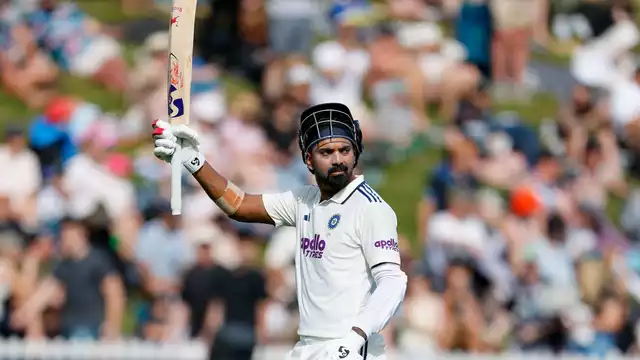
The preparations for KL Rahul's first Test innings in New Zealand had taken months. The opener claimed that he had been "thinking about Test cricket in New Zealand for the last six or seven months" after scoring 136 on Day 3 of the Wellington Test, making him the second Asian opener after Saeed Anwar to score hundreds in all four SENA nations.
Rahul stated, "Obviously, when you play Test cricket for that long, when you finish your career, you want to get at least that opportunity to challenge yourself in different countries and play against the best attacks." “Due to the challenging conditions, many batters in New Zealand have struggled to score runs. So I wanted to play a Test match here. I wanted to play a lot more, but unfortunately I haven't played here before this. I wanted to make the most of the opportunity when I got it. That's why I decided to come in early as well, just to get used to the conditions, because I have no prior experience of coming to New Zealand and playing red-ball cricket.
“For the past six or seven months, I've been thinking about Test cricket in New Zealand, trying to do my homework, and trying to figure out how the players who have scored runs here got there. So a lot of prep, a lot of homework. And once you've ticked all those boxes, it becomes slightly easier when you play the game.”
Watching video of batters who had won at these venues was part of that homework.
"I watched the last few years of Test cricket here,” Rahul elaborated. "West Indies, Australia, and England all played here recently. So I asked the analysts to send me some videos of guys who've got runs here. Harry Brook, particularly top-order batters, scored a lot of runs while Joe Root was present. It was interesting to see that there are a variety of approaches to scoring runs and that a variety of players have been successful here, despite the fact that I don't believe I can do what Harry Brook does.
“It just gave me a little confidence that it's not impossible to get runs in New Zealand. It necessitates a very precise game plan. So I went back to talking to my coach about what might be my best game plan, which we worked on for four or five months."
Rahul also spoke about how going back to being a Test opener helped him settle into a rhythm, and how watching other opening batters helped him find his mojo back.
“It helped a lot,” Rahul said. “There were 15-18 months when I didn’t open, played in the middle order, and then I had gotten into a habit of feeling bat on ball. When I went back to opening, I consciously tried to work on it in the nets. Sometimes less balls on the bat approach during sessions.
“Over the years, I've watched other openers and how they've been successful. Somebody like Alastair Cook. I used to watch him from slips and see how he batted. He left a lot of deliveries and made the bowlers bowl at him. It's the basics of cricket but sometimes that’s the most difficult bit. As I've gotten slightly older, I've worked on that again, and it's helped me a lot with opening."
Rahul had an early escape on Day 2, when New Zealand chose not to review an lbw appeal from Matt Henry that ball-tracking showed would have hit the stumps. He made a reference to someone else when asked if he owed Tom Latham a hug.
Rahul replied with a grin, "No, that's probably Glenn Phillips; buy him a few drinks after the game." “And also Tom Latham, because he had the decision to make. I honestly thought it might have hit me outside the line of off stump when it happened. That was how I felt. But some of the fielders felt it hit my bat. Probably the slowest 15 seconds of my life were those. I kept hoping that people would listen to Glenn Phillips, because he kept saying I smashed it. So thanks, GP, for that."
Rahul's initial response was brief when asked what had changed over the past two years to raise his Test score. "Runs. I scored more runs," he said, before elaborating further. Sincerely, I do not believe that much has changed. Since I received my Test cap, I have always prepared the same way. I've worked as hard as I am working currently. It was just that the runs weren't coming, and it's true that there were some technical difficulties as well. Perhaps I could have devised a more effective strategy. I don't think technique was the problem; rather, how I viewed the game has changed over time. The more you play, you recognise the mistakes you make and how you can get better. I'm fortunate to be able to turn that around with experience. But there's a lot more left for me to do."